Saturday, September 25, 2010

Wrap-up in Watamu – dung counts, poachers, and a continuing conflict


We wrapped up fieldwork in Watamu this week, capturing some more birds and collecting their fecal pellets, as well as trapping more arthropods. The fecal pellets have been sent to a forensics lab in Nairobi, where they will be scanned for DNA signatures of different types of insects, so that we can determine the composition of the diets of the birtds (and hence focus our data collection and conservation efforts on those species). We also finished recording turtle nesting habitat data along a 4km stretch of the beach; these data will be combined with similar surveys done throughout this year, so we can discern any patterns between beach condition and turtle nesting frequency.
On our last evening in Arabuko-Sokoke Forest, we did an elephant count data collection practice run. This consists basically of walking along a linear transect, noting any elephant dung piles nearby, and measuring both their distance from the transect as well as their stage of decomposition (from fresh to disintegrated). We’re setting our sights on doing a full comprehensive count in the spring, during the rainy season.
On our way into the forest, we learned that one of the rangers had had a near-fatal encounter with a poisoned elephant trap put in the forest by a poacher. This trap consisted of a sharp knife embedded in a log; the knife had been coated with a concentrated toxic paste of toxins that had been extracted from a local tree. The trap had been laid near a group of downed logs, so that passing elephants might not see it and step on it, injecting the poison into their foot. The poachers are interested in the tusks of the elephant; sadly, the black market for ivory in Africa continues to thrive despite a bevy of national and international restrictions/regulations. The ranger had accidentally stepped on the trap, but miraculously, had been spared because the poison had rubbed off onto his rubber boots before it was able to enter his bloodstream. He is still in recovery; meanwhile, the rangers are redoubling their efforts to find the poachers. This conflict between livelihoods and conservation continues to rage both here and across the globe – conservation biologists are finally starting to focus more on providing alternate sources of incomes for local peoples who historically have depended on hunting and other forms of extraction of biodiversity – but it may be too little, too late in many areas. For our part, continuing to unravel the mystery of how best to foster biodiversity in reserves like Arabuko-Sokoke may be some small help – the more that is known about the wildlife/biodiversity there, the more visitors to the area may include a forest visit in their beach-going itinerary – and hence the more revenues the Forest Service will receive for ongoing conservation efforts. The real trick is to tie things together so that locals (especially the residents of the 50+ villages that ring the reserve) also receive direct benefits from this cascade – and also begin to take more interest in sustainable forest stewardship.
For now, it’s kwaheri to Kenya – until next time!

Saturday, September 18, 2010

Jambo from Kenya!


Jambo from Kenya! I am on the east coast about an hour and a half north of Mombasa, at the Mwamba Bird Observatory & Field Centre. Nestled here at the facility on the Indian Ocean, I and three UWT students have been doing fieldwork for a few ongoing research projects. We spent the last few days in the nearby Arabuko-Sokoke Forest, catching birds in mist nets with a colleague (ornithologist Colin Jackson, Director here at Mwamba) and his team. As the birds are “ringed” (banded for future identification), we have been collecting fecal pellet samples that we’ll have analyzed at a forensics lab in Nairobi for DNA from different types of arthropods in order to better establish what the birds are eating. At the same time, we’re setting traps and catching ground-dwelling arthropods (beetles, spiders, etc.) in order to see where in the nearly 400 sq. km forests reserve their diversity and abundance is higher or lower. Since arthropods constitute a major part of many of the birds’ diets, we hope this work will go a long way towards better understanding (and ultimately protecting) several of the endangered species found here – especially the East Coast Akalat (Sheppardia gunningi), which is found almost exclusively here. This collaboration with the ornithologists here at Mwamba began in 2007, and we are making plans to continue for the next several years. One of the things we discovered last year was that African elephants (who roam freely in most of the reserve, constrained by an electrified fence that runs around most of the perimeter) seem to have a substantial effect on beetles and the organic leaf litter in which many of them thrive – could the elephants be having an indirect effect on the birds by affecting their food? One thing we’re doing as part of this investigation is attempting to count the elephants – next Wednesday we’ll do a practice run for a more comprehensive elephant count that we hope to conduct early next year during the rainy season. Counting elephants here consists mostly of counting piles of dung along kilometers of transects – the elephants themselves are very difficult to find in the dense forest cover!

Out on the beach, we’re undertaking another type of research. The beachfront here in Watamu is in fact a marine reserve, and it turns out to be very important nesting habitat for a variety of sea turtles. The turtles crawl up out of the ocean at night and deposit their eggs in the sand, making a Herculean effort that often takes two or three hours. The condition of the beach habitat is critical to their nesting (and hatching) success – so we are characterizing it in terms of the amount of plastic pieces and the quality of the vegetation covering the area. We are in the process of seeing if beach habitat condition correlates with nesting frequency – there is some evidence so far that the turtles do nest more often in those parts of the beach here that have more intact vegetation cover.
We’re here for another week or so doing fieldwork – then it’s back to Nairobi (a long dusty 10 or 11 hour drive on often rough roads) – I’ll give a talk on our research there at the National Museums of Kenya before beginning the long journey back home!

Friday, September 10, 2010

Notes from España


Greetings from Spain - I've been here the past two weeks attending a workshop and giving seminars. The workshop, which was held in La Mancha (the central region made famous in part by Cervantes' beloved fictional character, Don Quixote), focused on bringing an ecological modelling perspective to some particularly challenging problems in cancer biology. Our group of interdisciplinary scientists included applied mathematicians, ecologists, cancer biologists and physicians - and we spent several days trying to generate some new ideas to tackle some old problems. The workshop was sponsored by the James S. McDonnell Foundation and the Universidad de Castilla-La Mancha, and was quite productive - we have plans to publish some conceptual articles, submit some grant proposals for experimental work (my group focused especially on problems in neuro-oncology), and plan a larger follow-up meeting sometime in the next year.

Today I gave a seminar at the headquarters of the Estación Biologica de Doñana, an ecological research center based futher south in Seville, where I have been spending the last week. Tomorrow, I'm heading even further south - down to Kenya, where I'll meet up with a team of UWT students and head to the coast to continue research on elephants, birds, and arthropods. I'll post updates once work is underway there - our first big challenge will be to organize and conduct an elephant census in the Arabuko-Sokoke Forest!

Friday, July 16, 2010

Hummingbird moths and muddy roads


A new Earthwatch team joined us here in Tarrazú yesterday; we kicked things off with our customary hike through the Fundacion Nubotropica, a protected area in the forested watershed high above Santa Maria. Among the highlights of our first day were repeated sightings of "hummingbird moths" pollinating the shrubs near the meeting/eating hall. These moths, lepidopterans in the Sphingidae family, look and behave very much like tiny hummingbirds - but upon closer examination their six dangling legs give them away! Their close relatives in the Old World, in fact, fill the niche that would be occupied by hummingbirds (which are restricted to the New World, and thus absent in the Old World) and are a common sight in the summer gardens of many countries in Europe.


We got caught by some pretty heavy rain in the field this morning - had a spot of trouble driving out of the steep muddy road leading to the farm, in fact....tomorrow when we return to the farm to harvest the hymenoptera in our yellow pan traps we'll likely have to leave the Land Rover on solid ground and walk the 1-2km down into the coffee farm in order to avoid getting stuck - the joys of doing fieldwork in the rainy season here in Tarrazú!

Sunday, July 11, 2010

Week’s end in Tarrazú


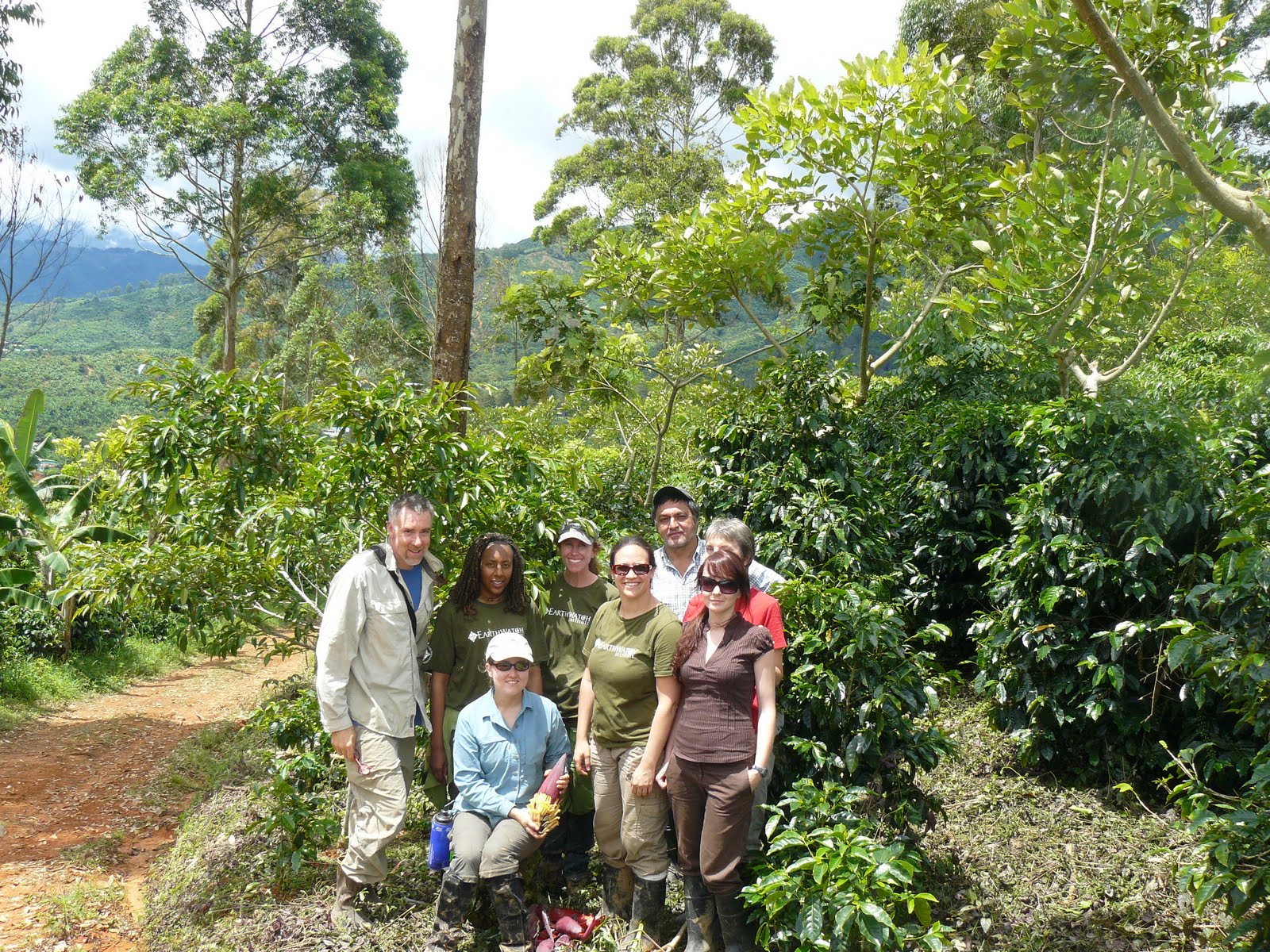
We have finished up a week of fieldwork in Tarrazú – Saturday evening we celebrated with a barbecue at a local farmer’s house, and the Earthwatch team departed early Sunday morning for San Jose. A second team will come in this next week, and we’ll resume work in the coffee fields…so far we have found, as might be expected, fewer bees in the coffee fields than we found during the coffee flowering season a few months ago. However, we have noticed quite a few bees in the forest habitats nearby some of the coffee fields – for instance, native stingless bees that like to make their nests in the knots of large trees. We’ll see if this trend holds up as we sample more farms and forests across the region.The Earthwatch team was treated to a private tour of one of the farms this week – Fernando, one of the coffee farmers with whom we’re working, stopped by his farm and showed us around, noting many of the non-coffee (shade) plants he has planted over the years. He noted especially several species of plants that “fix” atmospheric nitrogen, providing shade as well as natural fertilizer for the coffee shrubs. The forest habitat near his farm is particularly nice – the volunteers did a great job helping put in traps in the steep, dense forest!

Tuesday, July 6, 2010

Rainy season in Tarrazú


I’m back in San Marcos, Costa Rica, leading a few Earthwatch teams this month as we conduct more coffee sustainability research. This is a continuation of the work we started in April; the study is focused on better understanding the conservation value of forest fragments in and around coffee farms in the region in terms of an important ecosystem service: pollination. Building on recent research conducted elsewhere that indicates that having forests nearby coffee yields can enhance pollination, we are comparing pollinator diversity and abundance in both coffee farms that either have adjacent forest stands or are isolated from forest fragments. Coffee is able to self-fertilize, but can produce higher yields if it gets assistance from managed honeybees (imported European honeyebees, the same species commonly used in the U.S.) and other bees – these other bees, especially native stingless bees, are especially likely to be found nesting in forest fragments – hence the link between forest conservation and coffee yields. In April, we collected bees during coffee flowering season; now that the coffee flowering has ceased, we are trying to get a better idea of where the pollinators hang out during times when coffee is not flowering – hence we’re sampling in both coffee farms and nearby forest habitat.
This morning our first team of the month hit the field, helping set up yellow-pan traps to capture bees and wasps in both coffee fields and nearby forest areas. The team (six women from the U.S., Canada, and the U.K.) did a great job scrambling up and down the steeply terraced coffee fields…in addition to setting up bee traps, they also recorded timed observations of the number and type of pollinators flying through the fields, and measured ground cover (e.g., live plants, dead plants (mulch), and flowering plants that might serve as alternative resources for pollinators). Tomorrow we’ll go see what our traps have attracted; after we collected specimens from them, we’ll set up traps in another field – and then it’s back to the lab for an afternoon of sorting through specimens so that we can further identify the types of bees /wasps that we have captured.This afternoon, it is pouring rain, as is the norm for this time of year. As we head further into the rainy season, we’ll continue to do our work in the mornings, when we can generally expect at least a few hours of sunny, bee-friendly weather...
Yesterday as part of their orientation, the group was treated to a rare appearance of a male resplendent quetzal, famed trogon of Central America - lots of opportunity for close-up observation as he flitted from tree to tree alongside a dirt road we were descending after a hike through the forest at Fundacion Nubotropical - a terrific and auspicious start to the week!

Wednesday, May 5, 2010

Universidad de Costa Rica


I spent Monday morning at the University of Costa Rica with a colleague on the biology faculty, Paul Hanson. He is a specialist in the taxonomy of hymenoptera (bees & their relatives), and has been helping out with identifying the specimens we have been collecting in the coffee fields of Tarrazú for the past few years. This type of collaboration is essential in such a project – without proper identification, it would be impossible to understand the critical ecological roles played by the various bees we’re investigating – and hence the relative importance of the forest fragments where we’re working.

I also spent some time sterilizing some soil samples in the autoclave at the university – they were collected with the help of Earthwatch volunteers over the past few weeks as part of a collaborative effort with another UWT faculty member, Dr. Erica Cline. Erica is interested in mycorrhizal fungi, a symbiotic relationship between plant roots and fungi that is a good indicator for soil health (e.g., resistance to erosion, soil nutrition, etc.). It turns out that mycorrhizal fungi are the only producers of a substance called glomalin, which is a heat-resistant highly stable protein that can be easily detected in soil samples. With samples from many farms across the Tarrazú region, Erica is hoping to detect patterns connecting farmer practices (e.g., fertilizer use) and glomalin – which will give us yet another clue into sustainable best practices for coffee production in the region.


The bustle of San Jose is a stark contrast with that of the sleepy agricultural towns of the Los Santos region – truly like a different country. And further west, development along the Pacific coastal region is running rampant – this is definitely a country in flux. Martha Honey, who has written prolifically on ecotourism - and in particular the tradeoffs between economic development and the loss of socio-cultural and environmental integrity - wrote a poignant and blunt editorial this week in the Tico Times about the current state of (un)sustainable development in western Costa Rica. In the article she highlights the results of a study conducted by the non-profit Center for Responsible Travel (CREST) on the state of tourism development along Costa Rica’s Pacific coast, noting especially that a disturbing trend towards larger resort-style hotels and cruise-ship tourism is on the rise. This type of tourism is generally characterized by an increase in foreign-owned properties, and too often results in environmental degradation and the loss of local cultural as well as socio-economic stability – any increases in tourism-related jobs in resorts of these types tend to have little effect on the local economy as money tends to stay with the foreign owners and/or foreign staff they employ. The report, which you can read in full here, outlines strategies to balance this trend with deliberate movement back towards more sustainable ecotourism that provides benefits to both visitors as well as local people & the environment – usually yielding the type of travel experiences for which Costa Rica has become famous. As Oscar Arias (pictured below with me & my girls a few years ago in the village of Mastatal) winds down the last week of his second term as President here (his successor, Laura Chinchilla, will take office this coming weekend), it will be interesting to see the direction in which the new aministration leads the country.