Friday, July 16, 2010

Hummingbird moths and muddy roads


A new Earthwatch team joined us here in Tarrazú yesterday; we kicked things off with our customary hike through the Fundacion Nubotropica, a protected area in the forested watershed high above Santa Maria. Among the highlights of our first day were repeated sightings of "hummingbird moths" pollinating the shrubs near the meeting/eating hall. These moths, lepidopterans in the Sphingidae family, look and behave very much like tiny hummingbirds - but upon closer examination their six dangling legs give them away! Their close relatives in the Old World, in fact, fill the niche that would be occupied by hummingbirds (which are restricted to the New World, and thus absent in the Old World) and are a common sight in the summer gardens of many countries in Europe.


We got caught by some pretty heavy rain in the field this morning - had a spot of trouble driving out of the steep muddy road leading to the farm, in fact....tomorrow when we return to the farm to harvest the hymenoptera in our yellow pan traps we'll likely have to leave the Land Rover on solid ground and walk the 1-2km down into the coffee farm in order to avoid getting stuck - the joys of doing fieldwork in the rainy season here in Tarrazú!

Sunday, July 11, 2010

Week’s end in Tarrazú


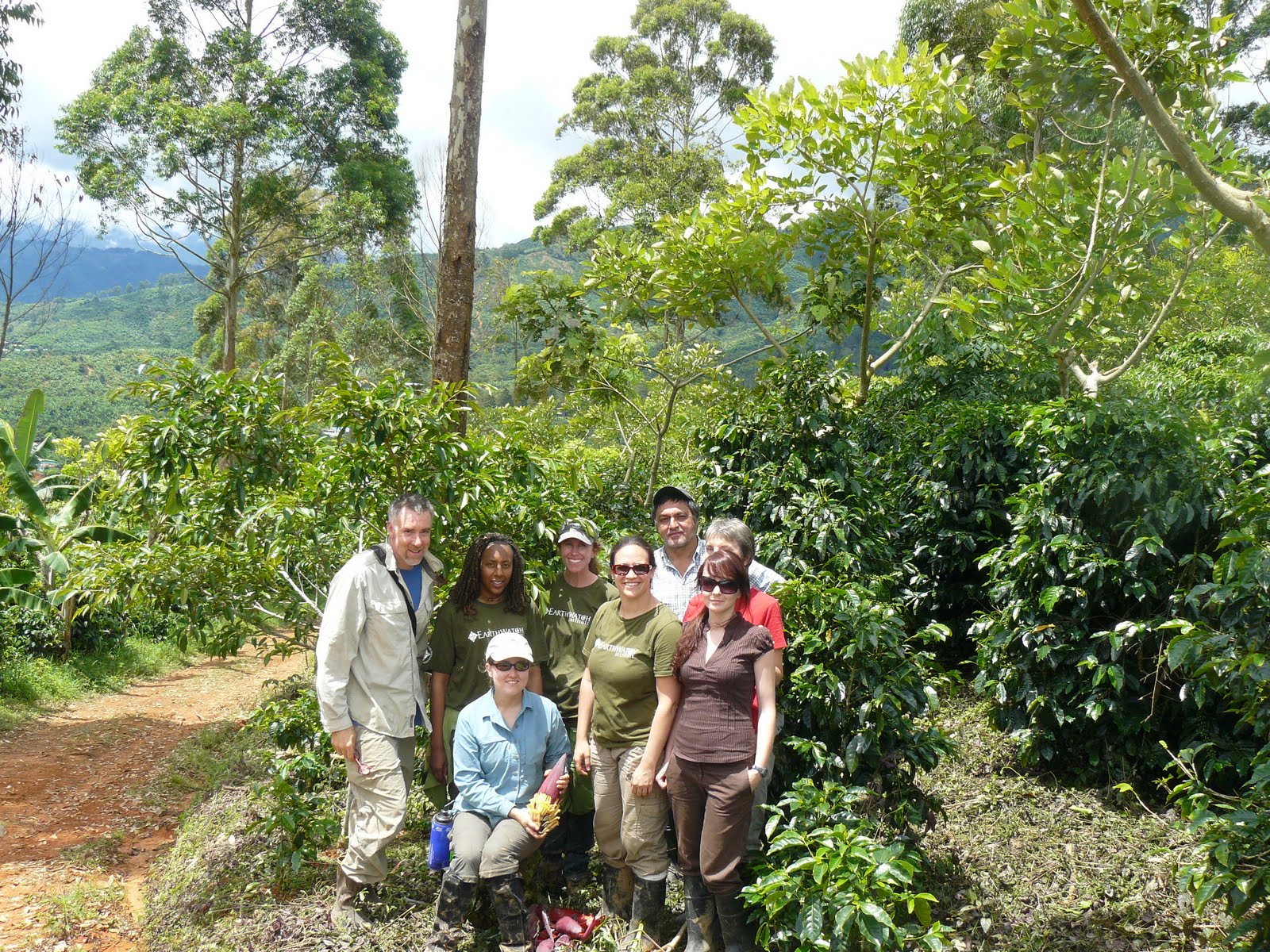
We have finished up a week of fieldwork in Tarrazú – Saturday evening we celebrated with a barbecue at a local farmer’s house, and the Earthwatch team departed early Sunday morning for San Jose. A second team will come in this next week, and we’ll resume work in the coffee fields…so far we have found, as might be expected, fewer bees in the coffee fields than we found during the coffee flowering season a few months ago. However, we have noticed quite a few bees in the forest habitats nearby some of the coffee fields – for instance, native stingless bees that like to make their nests in the knots of large trees. We’ll see if this trend holds up as we sample more farms and forests across the region.The Earthwatch team was treated to a private tour of one of the farms this week – Fernando, one of the coffee farmers with whom we’re working, stopped by his farm and showed us around, noting many of the non-coffee (shade) plants he has planted over the years. He noted especially several species of plants that “fix” atmospheric nitrogen, providing shade as well as natural fertilizer for the coffee shrubs. The forest habitat near his farm is particularly nice – the volunteers did a great job helping put in traps in the steep, dense forest!

Tuesday, July 6, 2010

Rainy season in Tarrazú


I’m back in San Marcos, Costa Rica, leading a few Earthwatch teams this month as we conduct more coffee sustainability research. This is a continuation of the work we started in April; the study is focused on better understanding the conservation value of forest fragments in and around coffee farms in the region in terms of an important ecosystem service: pollination. Building on recent research conducted elsewhere that indicates that having forests nearby coffee yields can enhance pollination, we are comparing pollinator diversity and abundance in both coffee farms that either have adjacent forest stands or are isolated from forest fragments. Coffee is able to self-fertilize, but can produce higher yields if it gets assistance from managed honeybees (imported European honeyebees, the same species commonly used in the U.S.) and other bees – these other bees, especially native stingless bees, are especially likely to be found nesting in forest fragments – hence the link between forest conservation and coffee yields. In April, we collected bees during coffee flowering season; now that the coffee flowering has ceased, we are trying to get a better idea of where the pollinators hang out during times when coffee is not flowering – hence we’re sampling in both coffee farms and nearby forest habitat.
This morning our first team of the month hit the field, helping set up yellow-pan traps to capture bees and wasps in both coffee fields and nearby forest areas. The team (six women from the U.S., Canada, and the U.K.) did a great job scrambling up and down the steeply terraced coffee fields…in addition to setting up bee traps, they also recorded timed observations of the number and type of pollinators flying through the fields, and measured ground cover (e.g., live plants, dead plants (mulch), and flowering plants that might serve as alternative resources for pollinators). Tomorrow we’ll go see what our traps have attracted; after we collected specimens from them, we’ll set up traps in another field – and then it’s back to the lab for an afternoon of sorting through specimens so that we can further identify the types of bees /wasps that we have captured.This afternoon, it is pouring rain, as is the norm for this time of year. As we head further into the rainy season, we’ll continue to do our work in the mornings, when we can generally expect at least a few hours of sunny, bee-friendly weather...
Yesterday as part of their orientation, the group was treated to a rare appearance of a male resplendent quetzal, famed trogon of Central America - lots of opportunity for close-up observation as he flitted from tree to tree alongside a dirt road we were descending after a hike through the forest at Fundacion Nubotropical - a terrific and auspicious start to the week!

Wednesday, May 5, 2010

Universidad de Costa Rica


I spent Monday morning at the University of Costa Rica with a colleague on the biology faculty, Paul Hanson. He is a specialist in the taxonomy of hymenoptera (bees & their relatives), and has been helping out with identifying the specimens we have been collecting in the coffee fields of Tarrazú for the past few years. This type of collaboration is essential in such a project – without proper identification, it would be impossible to understand the critical ecological roles played by the various bees we’re investigating – and hence the relative importance of the forest fragments where we’re working.

I also spent some time sterilizing some soil samples in the autoclave at the university – they were collected with the help of Earthwatch volunteers over the past few weeks as part of a collaborative effort with another UWT faculty member, Dr. Erica Cline. Erica is interested in mycorrhizal fungi, a symbiotic relationship between plant roots and fungi that is a good indicator for soil health (e.g., resistance to erosion, soil nutrition, etc.). It turns out that mycorrhizal fungi are the only producers of a substance called glomalin, which is a heat-resistant highly stable protein that can be easily detected in soil samples. With samples from many farms across the Tarrazú region, Erica is hoping to detect patterns connecting farmer practices (e.g., fertilizer use) and glomalin – which will give us yet another clue into sustainable best practices for coffee production in the region.


The bustle of San Jose is a stark contrast with that of the sleepy agricultural towns of the Los Santos region – truly like a different country. And further west, development along the Pacific coastal region is running rampant – this is definitely a country in flux. Martha Honey, who has written prolifically on ecotourism - and in particular the tradeoffs between economic development and the loss of socio-cultural and environmental integrity - wrote a poignant and blunt editorial this week in the Tico Times about the current state of (un)sustainable development in western Costa Rica. In the article she highlights the results of a study conducted by the non-profit Center for Responsible Travel (CREST) on the state of tourism development along Costa Rica’s Pacific coast, noting especially that a disturbing trend towards larger resort-style hotels and cruise-ship tourism is on the rise. This type of tourism is generally characterized by an increase in foreign-owned properties, and too often results in environmental degradation and the loss of local cultural as well as socio-economic stability – any increases in tourism-related jobs in resorts of these types tend to have little effect on the local economy as money tends to stay with the foreign owners and/or foreign staff they employ. The report, which you can read in full here, outlines strategies to balance this trend with deliberate movement back towards more sustainable ecotourism that provides benefits to both visitors as well as local people & the environment – usually yielding the type of travel experiences for which Costa Rica has become famous. As Oscar Arias (pictured below with me & my girls a few years ago in the village of Mastatal) winds down the last week of his second term as President here (his successor, Laura Chinchilla, will take office this coming weekend), it will be interesting to see the direction in which the new aministration leads the country.

Saturday, May 1, 2010

May Day in Tarrazú


We’ve wrapped up yet another week of fieldwork in Tarrazú, with a second team from Ernst & Young working in the field as well as in the lab discussing strategies with officials from CoopeTarrazú aimed at increasing farmer participation in supplying coffee to the cooperative. This latter issue is complicated by the fact that independent coffee buyers sometimes offer very competitive prices to farmers for their premium coffee beans, luring them away from contributing their coffee to the cooperative, which can undermine the cooperative’s ability to deliver the estimated volumes of coffee promised each year to their own buyers.


The EY team gave a presentation to CoopeTarrazu officials on Friday, in which they did a terrific job of providing cost-benefit analyses of different levels of farmer engagement and pricing schemes, as well as offering up some innovative solutions/incentives for increasing member participation. This was a great way to cap off a week of terrific work from the EY team – looking forward to working with more EY volunteers in the future!
In the field, we finished sampling hymenoptera (bees & their relatives) in all twelve of the farms involved in the current study – in a few days, I’ll bring all of the specimens to the Universidad de Costa Rica, where I’ll meet with a colleague who is a specialist in hymenopteran taxonomy. In the meantime, I’m organizing lab equipment and supplies, preparing for the next group of teams and more fieldwork when I return here in July.

Monday, April 26, 2010

Earth Day in Tarrazú

We celebrated Earth Day in Tarrazú by planting a tree in the garden of one of our Earthwatch colleagues. Tree planting is, of course, a perfect activity to undertake on this day – and the whole idea of sequestering carbon, offsetting some of the carbon in the atmosphere that contributes to global climate change meshes nicely with the research we’re doing on forest fragments here in the valley.
The Ernst & Young team finished up strong, completing several days of fieldwork as well as preparing and delivering a presentation to the management of CoopeTarrazú, the coffee grower’s cooperative with whom we’re working. We wrapped up the week with a barbecue at a local farmer’s house – smoked pork, rice and beans, and homemade tortillas!


Saturday afternoon I accompanied several of the Earthwatch volunteers down towards to the Pacific, stopping for a few hours in a small farming village to say hi to some friends at Rancho Mastatal, an environmental learning center that is often on the itinerary when I am leading UWT study abroad courses in Costa Rica. After touring the many sustainable building projects around the ranch (including a new biodigester, composting toilets, earth ovens, and a bevy of open-air buildings made mostly of local materials), we took a short hike in the rainforest, culminating in a refreshing swim in a nearby waterfall. I said goodbye to the volunteers after a dinner on the coast, and returned to Tarrazú late Saturday night, ready to greet a new team of volunteers on Sunday morning!

Wednesday, April 21, 2010

Wednesday morning at five o'clock

As the sun hinted it might soon peek out above the mountains that surround the valley here, several of us woke up this morning to go for a run through the streets and hills of Santa Maria. Running at dawn is a daily ritual for me when I'm doing fieldwork here, and while I usually enjoy some quiet introspection, I also enjoy it when volunteers join me for some exercise and conversation before breakfast. It's a great way to start the day - we arrive back energized and in time to clean up for breakfast at six, and then it's off to the lab and field!


Today was the third day working in the field with volunteers from Ernst & Young (EY). Coming from all over the U.S. and El Salvador, this group has energetically been continuing the work we started last week with the Fenway High School group. In addition to helping set up insect traps, pollinating coffee flowers by hand, observing & recording the frequency and type of pollinator visits to coffee plants, and assessing ground cover vegetation (as a proxy indicator for farmer practices such as herbicide use), the EY team has also been engaging in some great discussions with CoopeTarrazú about management issues. This morning they got a chance to check out commercial hives belonging to a local beekeeper (and coffee farmer – see below); donning bee suits, the intrepid volunteers were treated to an up-close and personal introduction to the busy bees in their honeycombed home.
I continue to be impressed by how engaged the farmers here are in the research we’re doing. Today I had some really interesting conversations with Francisco Alessandro Urena, a farmer who is participating in our study. Francisco is deeply interested in increasing sustainability on his farm – as a coffee farmer and beekeeper he is committed to finding ways of balancing coffee production and conservation. We discussed the current pollinator services investigation at length; during our conversation he enthusiastically noted that recent studies have suggested that bee-assisted pollination can increase coffee yields from 5 to 20%. This level of engagement and interest on the part of participating farmers is really a dream come true for an agroecologist – for me personally, it serves as an inspiration to work even harder to come up with useful information that will help further our understanding of ecological applications as well as help farmers who are continually grappling with issues of sustainability. As bees & their relatives are some of the most sensitive insects to pesticide poisoning, Francisco (and others like him in CoopeTarrazú) is trying to find ways of managing his farm in ways that will allow him to minimize his reliance upon chemicals. This is also an issue in avocado production (which he grows in addition to coffee), where several pests attack the fruits and render them too damaged to send to market. Biological control agents such as lacewings are in abundance in the area, and they do a terrific job controlling the pests – unless their populations get knocked down by excessive pesticide spraying. As you might imagine, attaining an environmentally sustainable balance between pest control and profits is a complex challenge – exacerbated by the fact that farmer practices on one farm may have a real impact on neighboring farms. For this reason, it is great working with a cooperative of community-minded farmers at coordinating a regional response to such challenges.